Write a Post
DP World is expanding its port in Posorja
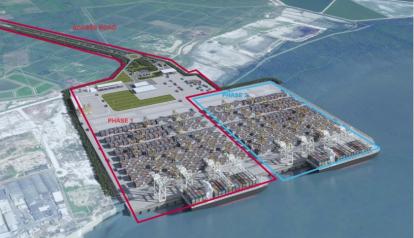
The Posorja Deepwater Port, operated by DP World, is expanding its capacity to handle more containers. With an investment of $170 million, the project is divided into two phases: the first will add 232 meters to the dock, bringing it to 700 meters, and the second will add another 100 meters. This will allow the port to handle two post-Panamax ships simultaneously and move up to 1.5 million containers per year.
Currently, the port is already operating above its capacity, having handled over 955,000 containers in 2023. This growth is partly due to Maersk, one of the world's largest shipping companies, relocating its operations from Guayaquil to Posorja in 2024. The Minister of Transport, Roberto Luque, emphasized that the demand has led DP World to accelerate its expansion plan.
Carlos Merino, CEO of DP World, explained that ports on the west coast of the Americas have struggled to meet the demand from shipping companies. The expansion will not only improve the port's efficiency but also boost Ecuador's competitiveness in the region. Additionally, DP World is developing a 120-hectare free trade zone near the port, which will further strengthen logistics and trade in the area.
The project, which will be completed by 2026, is part of a 50-year concession, after which the infrastructure will be handed over to the state. With these advancements, Posorja is solidifying its position as Ecuador's most important port, ready to tackle the challenges of global trade.
Source: Primicias.
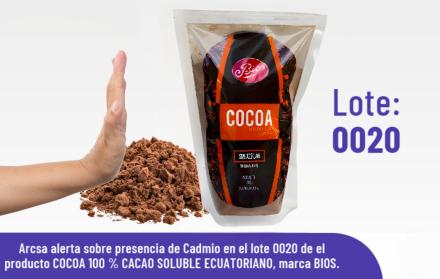
Arcsa Orders Recall of Contaminated Cocoa Batch After Finding Cadmium
A few days ago, Arcsa discovered methanol in an alcoholic beverage, which, like cadmium, can be harmful to health.
The National Agency for Health Regulation, Control, and Surveillance (Arcsa) has issued a new health alert after detecting heavy metal contamination (cadmium) in batch 0020 of the product Cocoa 100% Soluble Ecuadorian Cocoa, manufactured by Fábrica BIOS Cía. Ltda.
In a statement released on the afternoon of January 27, the agency warned that consuming foods with high levels of cadmium can lead to serious health issues, such as severe stomach irritation, vomiting, diarrhea, and long-term damage to vital organs like bones, lungs, and kidneys. This can significantly impact the quality of life for those who consume it.
According to the tests conducted, this batch does not meet the standards set by the International Codex Alimentarius CXS 193-1995, as the cadmium content exceeds the allowed limits. As a result, Arcsa has ordered the immediate removal of batch 0020 from the market and suspended the company’s Good Manufacturing Practices (GMP) certification.
Source: Expreso.
Petro responds to Trump’s tariffs with reciprocal measures and defiant rhetoric
Colombian President Gustavo Petro has responded defiantly to former U.S. President Donald Trump’s decision to impose 25% emergency tariffs on Colombian exports to the United States. In a detailed message shared on social media, Petro announced a reciprocal measure: a 25% tariff on U.S. exports to Colombia. He also instructed his trade minister to redirect Colombia’s exports to other global markets, emphasizing a shift away from dependency on the U.S.
Petro criticized Trump’s actions, stating that if the U.S. imposes a 50% tariff on Colombian products, Colombia will retaliate in kind. He encouraged Colombians to focus on domestic agriculture, particularly corn, and position themselves as global suppliers. The president’s tone was confrontational, rejecting efforts to ease tensions.
Petro dismissed the U.S. decision to suspend visas for him and his family, claiming he rarely travels to the U.S. and finds it unappealing. Despite his combative rhetoric, Petro hinted at a willingness to dialogue, inviting Trump to discuss their differences. However, he criticized Trump’s oil policies as harmful to humanity and referenced historical racial struggles in the U.S., urging unity among marginalized groups.
Petro accused the U.S. of attempting to overthrow his government, drawing parallels to past interventions in Latin America, such as the coup against Salvador Allende in Chile. He declared his intent to resist any economic or political aggression, asserting Colombia’s identity as a land of freedom and refusing to align with colonialist attitudes.
Source: El Colombiano.
Trump imposes tariffs and visa bans on Colombia in retaliation for migrant deportation dispute
This afternoon, U.S. President Donald Trump announced retaliatory measures against Colombia in response to President Gustavo Petro's refusal to accept flights carrying deported migrants from the U.S. Trump criticized Petro's decision, claiming it endangered U.S. national and public security. As a result, Trump imposed a 25% tariff on all Colombian imports, which will increase to 50% in a week. He also suspended visas for Colombian government officials and imposed travel bans on allies, supporters, and family members of Petro's administration. Additionally, Trump ordered enhanced customs inspections and tighter border security for Colombian nationals and cargo. Further financial, banking, and fiscal sanctions were announced, utilizing the powers granted by the International Emergency Economic Powers Act (IEEPA). Trump emphasized that these measures were just the beginning and vowed not to allow Colombia to violate its legal obligations regarding the deportation of criminals to the U.S.
Source: El Colombiano.
Petro responds to U.S. visa suspension after blocking migrant flights
Colombian President Gustavo Petro has responded to the U.S. Embassy’s decision to suspend visa services for Colombians. This comes after his government blocked military flights carrying deported Colombian migrants.
“There are 15,660 U.S. citizens living irregularly in Colombia. They need to approach our immigration services to regularize their status,” Petro said in a statement.
He also urged for continued dialogue on migration issues:
“I hope the discussion about the Darién Gap isn’t frozen. Without proper regularization, illegal activities will increase. We’ve seen this before, like when the U.S. blocked Venezuela, triggering a massive migration crisis. Colombia and Latin America deserve dignity. Migrants are human beings with rights and must be treated as such.”
U.S. visa services halted
On Sunday, sources from the U.S. State Department, led by Marco Rubio, confirmed that visa services at the U.S. Embassy in Colombia will be suspended starting Monday, January 27. It remains unclear how long the suspension will last.
Petro blocks U.S. military flights
In the early hours of Sunday, Petro announced his decision to block two U.S. military flights carrying deported Colombian migrants. One of the planes reportedly landed in Costa Rica, while the other returned to the United States.
“The United States cannot treat Colombian migrants like criminals. They must establish a protocol for dignified treatment before we accept these flights,” Petro wrote in a post on social media.
Initially, Petro stated that one plane was expected to land at 6:45 a.m. and the other at 10:00 a.m., urging Colombians to “welcome them with flags and flowers.” However, he later edited the post and clarified that the flights were military aircraft, which he ultimately chose to deny entry.
“Migrants deserve dignity”
“A migrant is not a criminal and must be treated with the dignity every human being deserves. That’s why I sent back the U.S. military planes carrying Colombian migrants,” Petro explained.
He added:
“I cannot allow migrants to be left in a country that doesn’t want them. But if they are returned, it must be done with dignity and respect—for them and for our country. In civilian planes, and without treating them like criminals, we will receive our fellow citizens. Colombia must be respected.”
Source: Noticias Caracol.
Strong 4.5 earthquake shakes Santander region: cities where it was felt
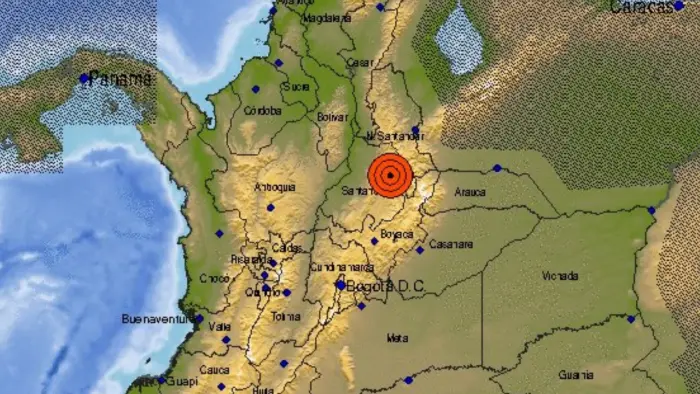
At 10:32 a.m. on Sunday, January 26, a 4.5 magnitude earthquake was reported in Los Santos, Santander, with a depth of 153 kilometers, according to the Colombian Geological Service (SGC).
Residents on social media noted the tremor was strongly felt in Bucaramanga, the capital of Santander, and surrounding municipalities near Los Santos.
Despite the moderate magnitude, local authorities reported no damage to buildings or infrastructure.
Los Santos is one of Colombia's most seismically active areas, accounting for about 60% of the country’s recorded earthquakes. Tremors are nearly a daily occurrence there.
While no damages have been reported, authorities remain on alert and encourage citizens to follow official safety recommendations.
Colombia experiences up to 2,500 seismic events monthly, underscoring the importance of preparedness and preventive measures across the country.
Source: Blu Radio.
United States halts visa processing for Colombians indefinitely
Diplomatic relations between the United States and Colombia have reached a new level of tension after President Gustavo Petro decided to reject flights carrying Colombian deportees from the U.S. In reaction, the U.S. government has indefinitely shut down the visa section at its Bogotá embassy and warned of further retaliatory measures.
Deportations: a routine practice
According to sources cited by Blu Radio, U.S. Customs and Border Protection (CBP) organizes two weekly repatriation flights, typically using commercial planes funded by the agency. These flights are aimed at expediting the return of Colombian migrants detained in the U.S. due to their irregular immigration status.
However, President Petro’s decision to stop accepting these flights—a practice previously approved by his administration—has triggered a swift and decisive response from the U.S. State Department.
Visa services suspended
Starting this Monday, the U.S. Embassy in Colombia will close its visa section indefinitely. This decision impacts thousands of Colombians who rely on these services to travel to the United States. The move is part of a broader series of measures the U.S. is evaluating in response to Petro’s stance.
Growing diplomatic tensions
The visa suspension is reportedly just the first step in a series of potential retaliatory actions being considered by the State Department. While specific details about further measures remain unclear, these actions are expected to increase pressure on the Colombian government to reverse its decision.
The diplomatic standoff over deportation policies highlights mounting tensions in migration and bilateral cooperation. This conflict affects not only diplomatic relations but also Colombian citizens seeking migration or exchange opportunities with the U.S.
For now, the Colombian government has yet to issue an official response. Meanwhile, relations between the two nations face one of their most challenging moments in recent years.
Source: Blu Radio.
La Mariscal: The Decline of Quito’s Former Nightlife Hub
La Mariscal, once Quito’s vibrant entertainment district, now feels abandoned. The newspaper Primicias visited the area on a quiet Tuesday night and noticed that the streets are nearly empty, with only a few people wandering through. The iconic Plaza Foch, once buzzing with tourists and nightlife, is deserted, with no police presence and only a handful of street promoters hoping to earn small commissions by drawing customers into sparsely attended bars and restaurants.
The businesses that remain open are struggling. Many establishments sit nearly empty, and owners are barely holding on, hoping for a turnaround that feels increasingly unlikely. The surrounding streets paint an even bleaker picture—boarded-up buildings, vacant lots, and signs advertising properties for rent are everywhere. Adding to the area’s challenges are the growing issues of homelessness, informal vendors, and drug activity, all of which contribute to a sense of insecurity.
Despite these struggles, a few places still attract a crowd. One rock bar on Lizardo García Street, for example, draws music enthusiasts who gather to sing along to their favorite bands. However, such energy is the exception rather than the rule, as most visitors remain on edge, constantly looking over their shoulders.
A Struggling Business Landscape
Local business owners describe the situation in La Mariscal as unsustainable. Many have been forced to close their doors due to a lack of customers. Efforts to revive the area through events like fairs and concerts bring temporary relief, but the crowds quickly disappear once the events end. A consistent, long-term plan to address the area's decline remains elusive, leaving business owners frustrated.
Security concerns are a major issue for both businesses and visitors. The absence of a coordinated safety strategy has left business owners to handle problems on their own, often resorting to desperate measures to keep their customers safe. The hospitality sector has also been severely impacted, with hotel occupancy rates plummeting and room prices dropping significantly.
A Delayed Recovery Plan
In 2024, the Quito municipality proposed a recovery plan for La Mariscal, outlining measures to stimulate investment, improve safety, and restore public spaces. However, the plan has been slow to move forward, and meaningful implementation could still be years away. The recovery process is expected to take as long as 12 years, leaving many questioning whether the area can hold on that long.
Key elements of the plan include reducing taxes to attract new businesses, revising zoning laws to encourage development, improving safety through collaboration between the city and police, restoring heritage buildings, and expanding green spaces. While these initiatives hold promise, the slow pace of progress has left many residents and business owners skeptical about the future of La Mariscal.
Narco Escort: Ecuador’s first narco novel
In less than 24 hours, Narco Escort by Andrés Salazar Silva shot to the top of Amazon’s charts in three categories: realistic fiction, fiction, and society. Released on December 17, 2024, it’s being celebrated as Ecuador’s first narco novel.
The gripping story follows Esmeralda, a woman from Ecuador’s coast, as she navigates a world ruled by corruption and organized crime. Salazar Silva, 44, spent five years crafting the 300-page novel, dedicating long hours during the pandemic to bring it to life.
Unexpected Success
To earn the bestseller badge on Amazon, a book must sell 3,500–5,000 copies in one day—a feat Narco Escort achieved effortlessly. A print version will be available in January 2025.
Salazar Silva was stunned by the response.
“I was nervous to check Amazon,” he said. “But when my assistant told me it hit number one in three categories, I couldn’t believe it.”
Why Write a Narco Novel?
Salazar Silva was inspired by the rise of insecurity during the pandemic.
“Mafias were growing nationally and internationally,” he explained. “I wanted to address these issues through fiction.”
Through Esmeralda’s journey, the novel not only explores drug trafficking but also delves into migration, human trafficking, and hope amidst chaos.
From Engineer to Author
An industrial engineer with a master’s in finance, Salazar Silva found refuge in writing during the pandemic, dedicating hours daily to complete his novel. Initially rejected by traditional publishers in Ecuador, he turned to Amazon, a decision that paid off.
What’s Next?
Narco Escort is the first in a planned trilogy, with the next books promising more action and depth. Salazar Silva is also working on a romantic novel, Sunset in Singapore, inspired by his time in Asia.
Source: Primicias.

Ecuador Proposes Flights for Ecuadorians Wanting to Leave the U.S. Voluntarily
The Ecuadorian government is rolling out a new plan aimed at helping undocumented Ecuadorians return home voluntarily from the United States. Foreign Minister Gabriela Sommerfeld shared the proposal, which comes in response to U.S. migration policies under former President Donald Trump that raised concerns over mass deportations.
Stepping Up Support for Ecuadorians Abroad
With fears of increased deportations, Ecuador is bolstering its efforts to assist citizens in the U.S., where it currently operates 12 consulates. Over the past year, the number of cases involving vulnerable Ecuadorians has surged by 150%, reaching over 1,400.
To meet this demand, more consulate staff will be sent to the U.S. "We’re preparing for what’s coming," Sommerfeld told Radio Centro. She also highlighted the government's focus on protecting Ecuadorians from human trafficking networks. "We want to stop this from happening and encourage Ecuadorians to stay in Ecuador," she said.
An Action Plan for Returning Ecuadorians
In response to stricter U.S. migration policies, Ecuador’s Foreign Ministry has developed a plan to support both forced and voluntary returns.
One of the key elements is the voluntary return program, which involves organizing flights for Ecuadorians who wish to return home. These flights, initially focused on those near the southern U.S. border, may expand to reach more Ecuadorians in other regions.
Shifting Focus to Migration Reform and Human Trafficking
Despite efforts led by President Daniel Noboa to push for the regularization of Ecuadorian migrants in the U.S., these initiatives have yet to succeed. Now, the government is shifting its focus to addressing human trafficking and promoting safe, regulated migration pathways.
Source: El Mercurio.
Rules for keeping pets in the canton of Cuenca
The rules for keeping pets in the canton of Cuenca are outlined in the Ordinance for the Control and Management of Urban Fauna and the Protection of Domestic Companion Animals. This ordinance highlights the responsibility of pet owners to ensure the safety and well-being of both their pets and the community. It specifies that pets must be kept within the property of their owners, and when taken for walks, owners must use appropriate control devices and clean up after their pets. The ordinance does not explicitly mention leashes as a control device.
What to do if you have lost a document in Colombia
In Colombia, you can skip filing a police report when you have lost a document:
No Police Report Needed: Under Decree 19 of 2012, you only need to affirm under oath that your documents are lost or stolen to start the replacement process.
Good Faith Matters: The Constitution (Article 83) presumes you’re acting in good faith, so a “lost document report” isn’t required for legal or administrative purposes.
Alternative IDs Work: According to Law 1801 of 2016, you can use other documents like a driver’s license, work ID, or even a student card to identify yourself while you get your replacements.
To replace your documents, just go straight to the right agency:
For ID cards, visit the National Civil Registry.
For passports, head to the Foreign Ministry.
For driver’s licenses, contact your local transit office.
For credit cards, notify your bank directly.
If you want to learn more about why you don’t need to file a report, you can visit this webpage: ¿Por qué no es necesario realizar el reporte por pérdida de documentos ante la Policía Nacional?
Collecting lost documents
Most municipalities have a designated place where found documents are collected. At police stations, they can tell you where this place is in your municipality.
Santa Marta: Secretaria de Planeación
Stolen documents
If a document has been stolen, you can file a report on this webpage: Sistema Nacional de Denuncia Virtual.
Lost foreign documents
If foreign authorities require you to provide a police report, it’s best to file a report for stolen items, even if the documents weren’t actually stolen.
Permanent Security Operations Promised Again on Cuenca-Molleturo Highway After Robbery
Once again, the Azuay Governor’s Office is promising constant security checks along the Cuenca-Molleturo-El Empalme highway after yet another robbery.
What Happened This Time?
This latest incident happened at kilometer 90 of the highway, where a van was attacked. Governor Santiago Malo has announced plans to activate permanent operations and boost security measures through CAMEX patrols. He acknowledged, “What’s happening on this highway is really concerning. The other routes are under control, but this one worries us.”
The governor also mentioned that the robbery is under investigation. He reassured the public that the victims received immediate assistance and emphasized that the police have been instructed to act swiftly in such cases moving forward.
Interestingly, this robbery took place while the van was heading toward Guayaquil, which is a change from past incidents, where attacks usually happened on vehicles traveling from Guayaquil to Cuenca.
Driver’s Frightening Experience
The van driver shared his ordeal with Diario El Mercurio. While driving along kilometer 90, a car suddenly blocked the road. Passengers quickly told him not to stop, fearing it could be a trap. “I thought that if I stopped, they’d think I was part of the criminals,” the driver said.
When he chose to accelerate instead, the attackers opened fire, injuring him. Despite being wounded, he managed to drive to the Hierba Buena area, where he received medical attention.
The driver revealed that the lack of cell signal at kilometer 90 makes the spot a favorite for robbers. “There’s no service in that area, so they take advantage of it to attack vehicles. We’re easy targets,” he said.
Luckily, the bullet only grazed his lung, and he’s now in stable condition. But he’s hoping authorities will take real action to protect drivers like him in the future.
Source: El Mercurio.
How To Get a Pawn Loan in Ecuador
A pawn loan is a type of secured loan where individuals exchange valuable goods, such as gold jewelry, for immediate cash. Unlike traditional loans that often require extensive paperwork, credit checks, and a strong financial history, pawn loans are more accessible. The growing number of unemployed individuals applying for pawn loans has doubled in 2024.
One of the key institutions offering these types of loans in Ecuador is Biess (Banco del Instituto Ecuatoriano de Seguridad Social). The following outlines how a typical pawn loan process works.
How Does the Pawn Loan Process Work?
Let’s imagine María, a single mother and small business owner, who needs $200 for a medical emergency. She owns a gold chain and decides to go to Biess for a pawn loan. Here’s how the process would unfold:
Evaluation of the Item: María brings her gold chain to a pawn loan office at Biess, where an appraiser assesses the authenticity and weight of the jewelry to determine its value.
Loan Amount Determination: Based on the appraisal, Biess offers María a loan amount that is a percentage of the estimated value. For example, if the chain is valued at $300, she could receive up to $200.
Loan Formalization: María presents her national ID, voting card, and a utility bill. She signs a contract, and the money is either provided in cash or deposited into her account.
Custody of the Collateral: The gold chain is held in custody by Biess for the loan term, which can last up to 180 days. During this period, María can make partial payments or settle the loan in full.
Recovery of the Collateral: Once the debt, plus any interest, is paid, María gets her gold chain back. If she fails to repay the loan, Biess may auction the jewelry. If the auction proceeds exceed the debt, María is entitled to the difference.
Biess is one of the leading institutions offering pawn loans, but private banks and cooperatives also provide similar financial products.olution to meet immediate needs without the usual qualifying hurdles.